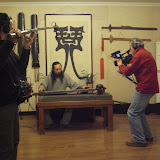
Interview of a Taoist Nun in her Temple in Beijing
Source :
News Xinhuanet
By Zhang Lei
BEIJING, March 17 -- The Taoist hermits rode the clouds, teleported through space and were once worshipped across the nation for their extreme pursuit of ultimate freedom. Yet the attractive philosophy of the ancients can sometimes seem somewhat out of step with modern cravings for conspicuous consumption. Even those who choose to separate themselves from the manmade material world soon find they must face challenges from the corrosive aftershocks of reform and opening-up.
 At first glance, the solitary Taoist nunnery of eastern Beijing looks deserted sat amidst the chilly gray smog of early spring. Youminguan's regular 10 or more priests prospered here, benefiting considerably in the 16th century from the old Grand Canal connecting Beijing to Hangzhou.
 The Cultural Revolution (1966- 76) soon ended that. For subsequent decades, all that remained was an ancient tree where villagers occasionally prayed. "It's efficacious," says nun Liu Chongyao, in her 50s, who took over this, the second-largest Taoist temple of the capital city in 2007 after its rebuilding in 2004.
In her Taoist hat and dark blue robes, this founder of a new nunnery looks younger than her years. "I always wanted to have a temple for Taoist nuns. Twenty years later, my dream came true," says Liu, sitting in an office with governmental regulations hanging on every wall. Fruits and candies are offered to guests at the tea table. "They are all donated by followers, including the rice and flour we eat," says the nun of nearly 30 years.
Since the Beijing Religious Affairs Bureau permitted her nunnery in August last year, Liu has had regular reasons to ponder the trade-off between seclusion and survival. She must grapple with an inconvenient truth that her religion needs money to drive forward. "If there were no worshippers, there would be no income from the incense," she says. "And then no nuns would come."
She has two disciples in the 1.6- acre temple. In the old days, free food and housing was all anyone needed, she says, but nowadays some would-be nuns will inquire about the monthly salary first. "Nearly all the priests and nuns have mobile phones and are saving for a computer," she says. "Some think bad luck will magically end once they are nuns. Instead, they encounter only yet more bad karma," she says. "You can't stop fate." Liu often tries to talk teenage girls out of a nun's life. She fears they will fall astray as temple life comes under assault from the temptations of rampant secular materialism.
Nationwide about 300 women a year used to become Taoist nuns back in the 1980s: mostly exiled from failed marriages, failed careers or from simply not thinking things through, she says. "Some come to regret it," she says. "It looks bad if they decide to return to secular life and so instead they focus on how they can make money and support their family. "'There are many priests at the doors of hell,' "she quotes the old saying. They should stick to their oaths, she says, even as their quality of living conditions improve. "Some people say religion should keep pace with the times like Shaolin Temple Abbot Yongxin, who revitalized the economy and Buddhism," Liu says. "But I'd rather go back and return to original simplicity."
'Wicked priests'
Yuan Ningjie, 22, a believer from the Zhengyi school, has traveled all over China visiting renowned masters in Jiangsu, Jiangxi and Hunan provinces of southern China. "I met wicked priests and cheats and doubted the Taoism legacy," he says. Just as not all Chinese officials do a good job, so some Taoist priests can fall into womanizing or corruption. "These con artists pepper the history of Taoism," he says.
There are two major schools: Quanzhen in North China and Zhengyi in South China. Compared with Quanzhen school where Liu belongs, Zhengyi school will perform the rituals and therefore form a closer connection with society. "My teacher in South China calls it 'doing business'," says Tao Guanjing, 27, a lay Taoist of the Zhengyi school from Beijing. Secularization is hardly anything new: It can be traced back to the middle of the Qing Dynasty (1644-1911) when priests of the Zhengyi school married and had children, Tao says. "The Zhengyi school ceased being a spiritual pursuit but instead became an occupation," he says. "They would go to the temple at office hours wearing robes but take them off when they were off-duty."
Government policy
Two years after taking over the nearly 700-year-old temple, Liu is attending conferences held by the Tongzhou district government and other organizations before the Chinese lunar New Year. "Actually nuns have no obligation to do these things," she says. "But I have no choice as religious communities are ordered to be 'in complete agreement' with the government." The government in late 2007 launched a scheme to build up groups of religious workers who are politically reliable, knowledgeable and morally convincing. "We should help and guide them to strengthen their self-supporting capabilities, improve self-management in accordance with the law, reflect the wishes of believers, and earnestly safeguard the legitimate rights and interests of religious community," said President Hu Jintao.
Temples are encouraged to finance themselves by selling incense, running stores or restaurants. The faithful are forbidden to conduct "superstitious activities disrupting social order or endangering people's physical and mental health”.
Most temples can get by on donations, says a director of the Beijing Taoist Association who requested anonymity. "Priests usually earn 500 to 1,000 yuan a month," he says.
Since 2008, Taoist priests have been qualifying for certificates from the local Taoist association, according to a document from the Chinese Taoist Association. The certificate provides proof of a priest's identity and recognition of their beliefs, the director says. Liu doesn't seem much interested in them. "I've been a nun almost 30 years with no certificate," she says. Religions wax and wane, she says. The Cultural Revolution, for example, forcibly returned thousands of priests and nuns to lay life. It is precisely under these testing circumstances that a Taoist should hold to their faith, she asserts。
New breed
 On the ninth day of the Chinese New Year, 30 Taoist priests gather at a Taoist temple in downtown Beijing to celebrate the birthday of the Jade Emperor. Standing or kneeling on the ground of Lüzugong Temple in gaudy red and yellow vestments, they chant and strike gongs from morning to night. Youthful yet poised, Chang Gaolu is among them, a 26-year-old successor to a 1,800-year-old religion. He entered Taoism at 19, after an illness was cured by a Taoist priest's prescription in his hometown in Shandong Province. It just hit him, Chang explains. He was coming down a Taoist mountain from a holy place one day when he burst into tears asking himself, "Why didn't I become a Taoist earlier?" At 22, the Taoist became manager of a Taoist temple in northeast Pinggu district of suburban Beijing. "Taoist teaching is rich and occult, transcending the material world," he says. "It embodies traditional Chinese thinking, the Book of Changes, martial arts, alchemy and feng shui. "Each field requires years of study." Usually he meditates, chants or studies the classics at temple. Although secluded, the Taoists study modern knowledge, he says. "I log onto the Internet to check the news, such as the Winter Olympics. It's important we keep up with the times."
 Alleged decline
Since 2003, the Chinese Taoist College has been open to priests and nuns to earn an associate or master's degree in temple management. There are more than 5,000 Taoist temples and 50,000 Taoist priests and nuns on the Chinese mainland by 2007, according to the Chinese Taoist Association. Religious policy and management is good in China, Liu says. The problem to her mind is a lack of proper practitioners. "Taoist temples abound, but Taoist priests or nuns aren't so easy to find, unlike the Buddhist nunnery on Wutai Mountain that attracted more than 300 nuns to live at temple and follow monastic rules. In comparison with its imported rival, Taoism's image is tarnished, she says. She sees these failings, for example, demonstrated by a lack of dress code. "They don't even wear robes or grow their hair, but the Buddhists are good at building up their im-age," she says. "They wear the garb and shave their hair whenever they are in public."
Taoism is declining, believes the well-traveled Yuan. "No one has been able to arrest its decline since its peak in the middle of the Ming Dynasty (1368- 1644),"he says. Perhaps it is their individuality that makes Taoists so slow to unite. Sects refuse to obey each other, he says. A revival would depend on an overhaul of the education system, Yuan believes.
"Since the modern Taoist college teaches prevailing political theory rather than Taoism, it can hardly be compared with a Buddhist college or seminary. "If only Taoism could attract a better class of believers – true intellectuals – that might conjure some hope."
Fast facts: Mystical rituals of Taoism
Talisman (符箓 fulu)
Paper strips with scribbled mystic words or symbols are empowered to bring luck or drive demons away. It's a kind of spell achieved through qi transmission to protect the body, guard the home, ward off bad luck, summon a deity or cure a disease.
Exorcism (驱邪 quxie)
Some go mad from a yin-yang disorder, harassed by pathogenic factors. A practitioner burns paper or incense, uses a talisman, instruments or incantations to drive away evil.
Fortune telling (占卜 zhanbu)
The original Taoists claimed supernatural oracle powers. For a priest, it's also a handy way to make a living.
Meditation (内丹 neidan)
Internal alchemy uses mental movements and meditation to promote circulation of qi within the human body. A body can support itself if trained to a certain level. If the inner universe is properly linked to the outer world, then food becomes more or less unnecessary. Practitioners in fact eat little, only herbs and fruit in some cases. They also claim to absorb the essence of the sun and the moon.
Elixir (外丹 waidan)
As an approach to immortal life, an elixir is often made from lead and mercury in Taoist alchemy. It won't work for everyone, but is more like a catalyst for advanced practitioners.
Taoist medicine (道医 daoyi)
As Taoist meditation is based on the five elements – metal, wood, water, fire and earth –and theory of meridians and collaterals, many Taoists are proficient in Chinese medicine. Some Taoists have secret recipes handed down for generations.
(Source: Global Times)